
Recording a contract
The arrangement, not the supplier, is what most obligations actually attach to — which is why this register carries more than a renewal date.
A vendor is a counterparty. A contract is the arrangement you have with it — and under most third-party regimes, including DORA, it is the arrangement that carries the obligations, the terms and the reporting. One vendor can hold several, and they can be classified differently.
Add a contract
Section titled “Add a contract”From Vendors → Contracts, choose Add contract — or open a vendor and use its Contracts tab, which pre-fills the vendor for you.
-
Vendor and timing. Which counterparty, and the dates: start, end, notice and renewal. These drive every “what expires when” view you will later rely on.
-
Financial. Contract value and currency. Worth filling even when it feels like procurement’s business — concentration analysis is a money question as much as a count.
-
Arrangement details. What kind of arrangement this is, and the contract type and status from your own configured lists (see Setting up your organization).
-
Service characteristics. What the vendor actually does for you, and how replaceable they are: substitutability runs from easily substitutable to not substitutable. This is a judgement, and it is reported.
-
Business functions. Which of your functions this arrangement supports. Linking them is what turns a contract register into a dependency map — and what makes a Register of Information possible to produce at all.
Save, and the contract opens with its own tabs.
What hangs off a contract
Section titled “What hangs off a contract”- Documents — the signed agreement, the DPA, the SLA, amendments. Upload them here; earlier versions are kept rather than replaced.
- Clauses — the contractual-provision assessment (below).
- SLA — service levels and the KPIs measured against them.
- Approvals — the sign-offs recorded against this arrangement.
The clause gap register
Section titled “The clause gap register”Under DORA, Article 30 lists provisions a contract for ICT services must contain. Vendorica assesses your contracts against that list and keeps the result as a register: per contract, which provisions are present, which are partial, and which are missing.
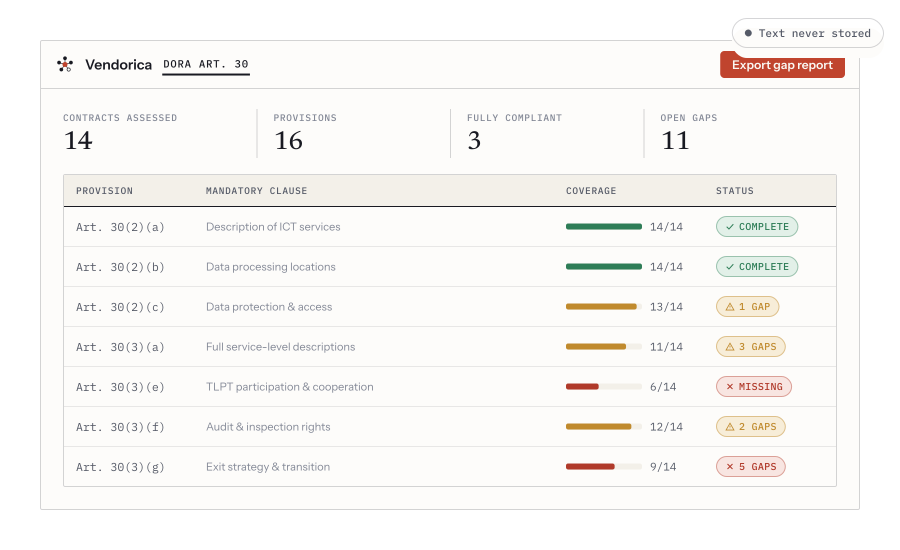
The Article 30 gap register — the mandatory provisions as an org-wide checklist, each row showing per-contract coverage.
Read it as a renegotiation queue rather than a score. A missing provision on a low-criticality arrangement can wait; the same gap on a contract supporting a critical function is the conversation to have at the next renewal.
Two habits worth keeping
Section titled “Two habits worth keeping”- One arrangement, one contract row. A master agreement plus three order forms is usually one arrangement, not four — but if they carry different services or different terms, split them. The test is whether they would be reported separately.
- Record the end date even when it renews automatically. “Evergreen” is a renewal cadence, not the absence of one, and a contract with no dates is invisible to every expiry view in the product.