
Scoring, treatment and appetite
Inherent is the world without your controls; residual is the world with them. The gap between the two is your compliance programme, stated as a number.
Every scenario is scored twice, on likelihood and impact.
- Inherent — how bad it would be with none of your controls in place.
- Residual — how bad it is given what you actually have.
Score inherent first and honestly. The temptation is to score it low because you have controls; that is what residual is for, and doing it in the wrong place hides the value of the controls you are paying for.
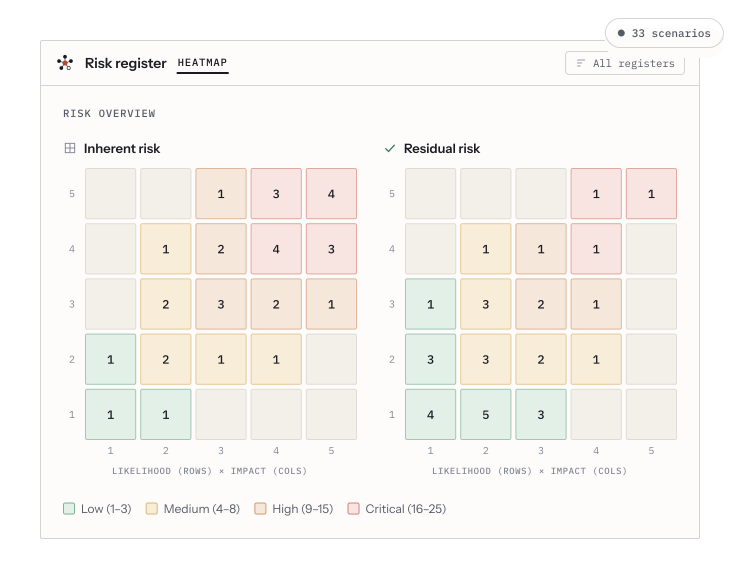
The two heatmaps side by side: the same scenarios plotted before and after your controls.
The scales are yours
Section titled “The scales are yours”Settings → Risk carries the likelihood and impact scale labels, the risk categories and the approval workflow. Set the labels to the ones your risk policy already uses before anyone scores anything — rescoring a register because the words changed is nobody’s good afternoon.
The four treatments
Section titled “The four treatments”Every scenario takes one:
| Treatment | What it means |
|---|---|
| Mitigate | Do something to reduce it. Needs a plan. |
| Accept | Live with it, knowingly and on the record. |
| Transfer | Move it — insurance, a contractual term. |
| Avoid | Stop doing the thing that creates it. |
Mitigate asks for a treatment plan: concrete actions, owners, timelines, and a target resolution date. “Improve monitoring” is not a plan. Accept is a perfectly respectable answer and often the right one — the difference between accepting a risk and ignoring it is that the first is written down, dated and approved.
Approval
Section titled “Approval”Where your organization has enabled it, a scenario goes through an approval workflow: Submit for approval, then approved or rejected with a reason. That is how a residual score stops being one person’s opinion and becomes the organization’s position.
Appetite
Section titled “Appetite”Risk → Appetite states how much risk of each kind the organization has agreed to carry, and shows where you currently sit against it. Each statement sets a tolerance limit — for a category, against a metric such as average or worst residual score.
This is the page written for a board rather than a practitioner, and it is the one that makes the register consequential: without a stated line, a rising number is an observation, and nobody has to do anything about an observation.
Indicators keep it current
Section titled “Indicators keep it current”Risk → Indicators holds key risk indicators — measured numbers with amber and red thresholds, on a cadence, sourced by hand or from automated test results. A crossed threshold raises a review task; it never silently changes a rating. A number that moves a risk score without a human deciding is a number nobody trusts by the second quarter.
Proving it moved
Section titled “Proving it moved”Risk → Snapshots freezes the register on a date. Two snapshots and a trend chart answer “is this getting better”, which is the only risk question a board actually asks.