
Tasks and task sets
Your queue is the product's answer to "what should I be doing"; task sets are how it gets filled without anyone remembering to fill it.
My Tasks
Section titled “My Tasks”My Tasks is your own queue, in three tabs: Due, Overdue and Completed. Each row shows the task, its source — what created it — its due date and status.
The source column is the one to read. A task that says policy renewal is telling you it came from a policy’s review cycle; open the linked record with Open linked entity rather than trying to remember which policy it was.
Three actions per row:
- Complete — done. Select several and complete them together.
- Skip… — deliberately not doing it, with a reason. Skipping is a recorded decision, which is why it asks.
- Reschedule… — move the due date.
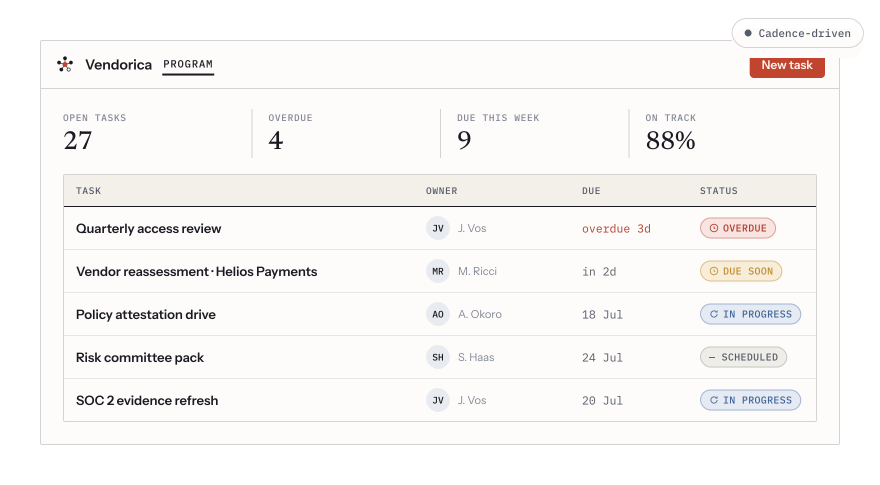
Open, overdue and due-this-week across the programme, with owners and lifecycle status.
Where tasks come from
Section titled “Where tasks come from”You rarely create a task by hand. They arrive from the work: a policy review falling due, a corrective action opened under a finding, an onboarding step, an access review item, a vendor reassessment coming round on its tier’s cadence.
That is the design. A task in Vendorica always points at a record, which is what makes “done” mean something specific.
Task sets
Section titled “Task sets”Task sets are reusable step sequences that fan out when a trigger fires — an onboarding checklist, a leaver routine, a post-incident review sequence.
-
New task set, and give it a trigger: the event that starts it — a contract created, an incident raised, a finding raised, and others.
-
Add conditions, if this set should only run for some occurrences of that trigger. All conditions must hold. No conditions means it starts every time the trigger fires.
-
Add steps. Each step is a task: a title, a description, an owner and a due offset in days. Drag to reorder — steps run in the order shown.
-
Choose each step’s owner strategy. A specific user, a personnel group (round-robin), the person the trigger fired for, or that person’s manager.
-
Read the preview. It shows what would be created if the set were instantiated today, resolved owners and all. If a step shows an unresolved owner — an empty group, say — fix it now rather than discovering it when the trigger fires.
A word on manual runs
Section titled “A word on manual runs”Conditions gate the trigger, not a manual run. If you start a task set by hand, it runs — an explicit instruction is a decision that has already been made.